
2026/01/17
15:35 Liquid Glass
I just disabled liquid glass from my MacOS 26 machine, and I found out that Apple includes all the old features that were removed with apple glass, see for example "compact mode" in Safari:
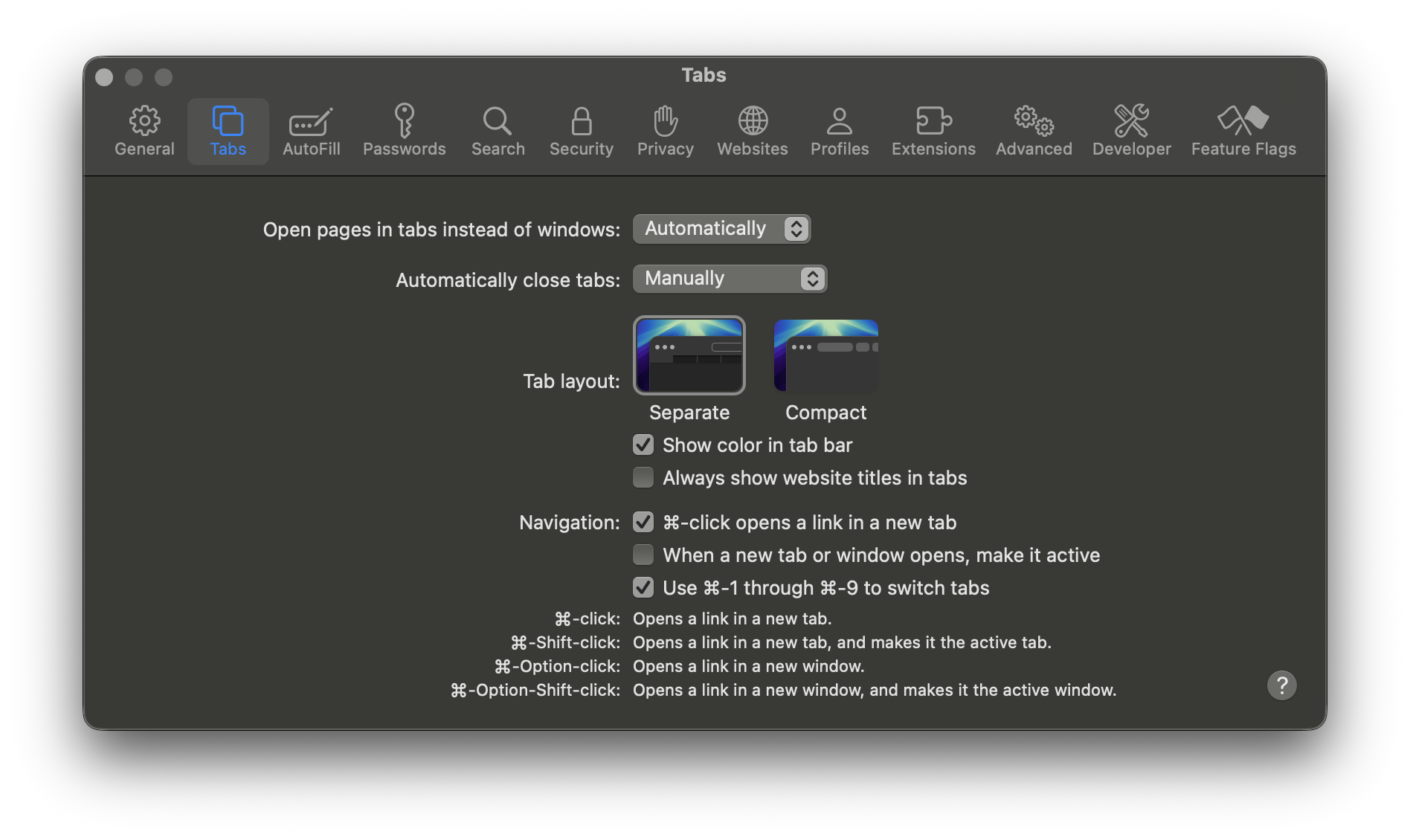
Maybe a kind of Bug compatibility. #Apple Glass
17:17 recursion in Scala
Avoid writing the following form of recursive functions:
def fib(n: Int): Int =
  if (n <= 1) n
  else fib(n - 1) + fib(n - 2)
This usually cause exponential time even when optimized. Imagine a call to fib(n) goes as follows:
fib(n)
├─ fib(n-1)
│  ├─ fib(n-2)
│  └─ fib(n-3)
└─ fib(n-2)
   ├─ fib(n-3)
└─ fib(n-4)- fib(n-2) is computed twice
- fib(n-3) is computed three times
- fib(n-4) is computed five times
Instead, you should use a local tail-recursive helper:
def fib(n: Int): Int = {
  @annotation.tailrec
  def loop(i: Int, prev: Int, curr: Int): Int =
    if (i == 0) prev
    else loop(i - 1, curr, prev + curr)

  loop(n, 0, 1)
}
Now, something important to note here, if someone changes anything in the function call, it will break, silently. Moreover, the meaning of prev / curr isn’t obvious from the signature, which is important in functional programming; the invariant is not enforced by the type system. This is usually acceptable because:
- loop is local → no external caller can misuse it
- The invariant is encapsulated, not exposed
- The outer API fib(n) remains clean and total
17:25 Currying
"This is named after the mathematician Haskell Curry, who discovered the principle. It was independently discovered earlier by Moses Schoenfinkel, but Schoenfinkelization didn’t catch on." Lol. #Mathematics