Learning is the change taking place in a system; it can be either permanent improvement of the systematic work or permanent change in the behavior of the organism.
In a complicated system, a change in learning is due to many reasons; that is to say, there are many forms of the learning process in the same system, and its different parts will undergo different improvements. People can set new production rules and set up new behaviors.
Following figure provides a proposed framework for learning.
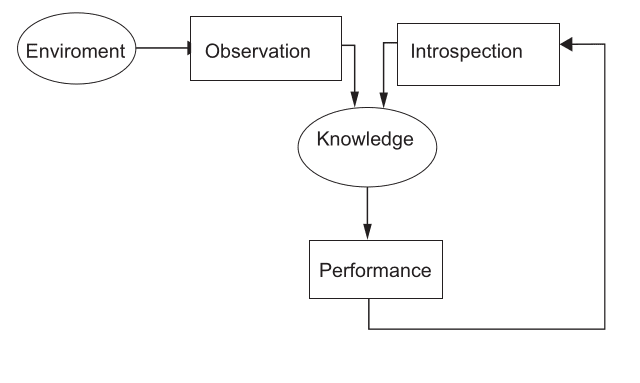
The principle of learning is that the learner must know the last result, i.e. whether the behavior can be improved. It’s better for learner to get information about which parts of the behavior are satisfied and which parts are not.
Learning theories
The following is a brief introduction to a list of the most widely-known learning theories.
Behaviorism
The characteristics of the theory are as follows:
- It emphasizes that psychology is a science, so we should pay attention to experiment and observation in method and only observe and record the explicit behavior in the research subject.
- The basis of explaining constitutive behavior is the individual’s external reaction, and the formation and change of the reaction is the course of restriction.
- Paying attention to the influence of environment on individual behavior and not recognizing the importance of individual free will are regarded as determinism.
- In education, it advocates both reward and punishment, neglects internal motivation, and emphasizes the training value of external control. Behaviorism became popular in the United States and extended to the
Behaviorism is a significant learning theory that has greatly contributed to our understanding of human behavior and the learning process. It emphasizes the role of observable behaviors and external stimuli in shaping and modifying behavior. Behaviorism has provided valuable insights into how individuals acquire new knowledge and skills through conditioning, reinforcement, and punishment.
One of the strengths of behaviorism lies in its focus on objectivity and empirical evidence. By emphasizing observable behavior, behaviorists have encouraged rigorous experimentation and measurement, enabling the development of precise theories and interventions. This approach has been particularly influential in fields such as psychology, education, and behavior management.
Behaviorism has also highlighted the importance of environmental factors in shaping behavior. It recognizes that individuals' behaviors are influenced by their interactions with the environment and the consequences of their actions. This perspective has led to the development of effective behavior modification techniques, such as operant conditioning, which can be applied in various contexts to bring about positive behavioral changes.
However, behaviorism has its limitations. Its exclusive emphasis on observable behaviors has been criticized for neglecting internal mental processes, subjective experiences, and individual differences. It fails to fully account for cognitive processes such as perception, memory, and problem-solving, which are crucial in human learning. Additionally, behaviorism's reliance on external reinforcement and punishment as primary mechanisms of learning has been questioned for its limited consideration of intrinsic motivation and the role of internal rewards.
Despite these limitations, behaviorism remains a valuable framework for understanding and modifying behavior, particularly in contexts where observable outcomes are the primary focus. It has paved the way for the development of subsequent learning theories that incorporate cognitive and socio-cultural factors, offering a more comprehensive understanding of the learning process.
TODO Association
From the end of 19th century to the beginning of 20th century, Thorndike’s learning theory had occupied the leadership in American psychological circles for nearly 50 years. Thorndike is the pioneer of animal psychology at Harvard University. Since 1896, he systematically studied animal behaviors by using a chicken, cat, dog, fish, etc., thus first putting forward the most intact learning theory in learning psychology. Through the scientific experiment method, he found that individual learning is via a kind of “try to be successful accidentally by mistake.” In this way, a kind of connection or combination between stimulus and response is established through repeated responses to a stimulus. In Thorndike’s view, the essence of learning lay in forming the association between situation and response. So this kind of learning theory is known as association theory.